Skip to content
2026 Chinese multimodal · Issue 06Data as of Oct 18, 2026

2026 China Native
Multimodal LLM Tier List
compared, scored, explained.

Qwen3.8-Max takes the top spot at 95.4, with Doubao Seed 2.0 Pro at 95.2. Under our method a 0.2-point gap is the same band — what actually separates them is the evidence grade: one is B, the other A.

After two expansions the board holds 32 models: from InternVL 4.0 (open-source perception 96) and NeuroXess-N1 (the only neural-signal modality anywhere) to six industry-scenario entries — Hikvision Guanlan, Cloudwalk Congrong, Zidong Taichu, Ant Ling 2, JD Yanxi 2 and NetEase Fuxi 2. Score points rise from 160 to 256, and the evidence spectrum reads 14A / 16B / 2C — the evidence column discriminates for the first time.

The document leader is still not the overall leader: it is an OCR-only specialist, and it ranks 20th. This list does not decide “who is best” for you. It gives you replaceable weights, checkable sources and a framework you can take into a selection meeting.

32models
8dimensions
256score points
14grade-A
See all 24

Lead essay

A new #1 — and eight “no second place” models at the bottom of the board

8 min read · data as of 18 Oct 2026 · editorial desk

30-second answer

Qwen3.8-Max leads at 95.4 (evidence B); Doubao Seed 2.0 Pro is second at 95.2 (evidence A). Anything inside 0.5 counts as one band, so this is a tie for first. The bigger change is at the bottom: after two expansions, at least 15 of the 32 models appear in no mainstream comparison, spread across a dozen-plus “no second place” scenarios — surveillance, finance, e-commerce, games, neural signals. Selection still splits by scenario: DeepSeek-OCR 2 for document batches, Doubao for long video, DeepSeek-V4.1-Flash for budget work, Kimi K3 for self-hosting, Hikvision Guanlan for surveillance, NeuroXess-N1 for neural signals.

The top of the board changed this cycle. Qwen3.8-Max scores 95.4, Doubao 95.2 — a gap of 0.2. Our method treats anything under 0.5 as the same band, so this is not an overtake, it is a tie. Perturbing all eight dimension weights by ±30% across 2000 runs puts Qwen first in 91.1% of reasonable weight vectors and Doubao first in 8.9%.

What separates them is not the score but the certainty. Qwen3.8-Max is grade B: vendor-reported benchmarks, under 30 days old, no independent third-party reproduction. Doubao is grade A. That is why this site prices capability risk and certainty risk separately — the composite tells you who is stronger, the grade tells you how likely "stronger" survives the next release. For a three-year contract, trading 0.2 points for a grade-A trail is usually a good deal.

Two expansions: from technology-form cold to industry-scenario cold

The first expansion improved technology-form coverage: InternVL 4.0 (85.0, #16) is a perception specialist — top-three downloads in the open-source community, nearly absent from Chinese comparisons, perception 96, MIT, grade A; NeuroXess-N1 (77.2, #30) puts EEG/fNIRS signals, images and text in one token space — the only grade-C model here and the only entrant in neural-signal decoding. The second expansion supplies the other half, industry scenarios: Hikvision Guanlan (surveillance, grade C), Cloudwalk Congrong (recognition), Zidong Taichu (academic all-modality), Ant Ling 2 (finance, Chinese 92), JD Yanxi 2 (e-commerce images) and NetEase Fuxi 2 (game content). All six composites sit between 76 and 81, yet each is a “no second place” in its scenario. The evidence spectrum reads 14A / 16B / 2C — the evidence column discriminates for the first time.

The most commercially interesting of the four frontier releases is DeepSeek-V4.1-Flash: ¥0.6 per million output tokens, document 95, open weights, and the second-cheapest point on the 1024px cost-per-1,000-images curve at ¥0.54. The only model below it (MiniCPM-V 4.5 at ¥0.45) scores 79.6 overall. This is the first time "cheap" and "capable" land on the same model. Its limits are equally clear — video 78, generation 72 — so do not use it for video QA or creative work.

Thirteen months of the leaders

Editorial mappings, re-scored under one weighting; not launch-day vendor numbers.

Qwen3.8-MaxDoubao 2.0 ProQwen3.5-397BGLM-5.3Kimi K3DS-V4.1-FlashInternVL 4.0
808590952025-092025-122026-032026-062026-092026-1095.495.294.692.492.387.985.0

← scroll for the full trend →

Top fiveOverallDocsVideo¥/M
Qwen3.8-Max S+95.49793¥18
Doubao Seed 2.0 Pro S+95.29696¥15
Qwen3.5-397B-A17B S+94.69792¥12
GLM-5.3 S92.49488¥9
Kimi K3 S92.39290¥16

Why the document specialist ranks 20th

DeepSeek-OCR 2 scores 81.9 overall and ranks 20th, yet its document dimension is 99 — the highest in the field, two points above Qwen3.8-Max. The reason is coverage: no video, audio, generation or agents, so the weighted score drags it down.

That is both the value and the trap of a weighted list. If documents are your only workload, raise document weight from 18% to 60% and zero out video, generation and agents. DeepSeek-OCR 2 enters the top three; the overall champion may leave the top five. A ranking is a set of editable assumptions. For specialists, the correct move is to read the dimension sort directly — the overall rank has near-zero predictive power for them.

How to use it

  1. Sort by your primary scenario: documents, video or agents.
  2. Read dimension scores for the top three, not the composite.
  3. When the scenario is cold (industrial QC, vertical classics, neural signals, open-source deployment), check the mini tier list and the cold-model matrix before the overall board.
  4. Add deployment, budget and Chinese constraints in the picker; the shortlist usually falls to 3–5.
  5. Run 50–100 real samples in a PoC; if it conflicts with the list, trust the PoC.

We deliberately avoid a single correct answer. Change the weights and the winner changes — this cycle's 91.1% versus 8.9% is the proof. Not because the list is unstable, but because selection should work that way.
Overall ranking

The 2026 Chinese multimodal tier board

Composite = eight weighted dimensions. S+ ≥ 94, S 92–94, A+ 89–92. Within a tier, models are ordered by score; gaps under 0.5 count as level.

Full ranking & filters

Click a model for its dossier. Tier colour reflects the composite band only, not single-task ability; see dimension leaders below.

Test gallery

Four difficulty levels, four evidence sets

Each scenario maps to a checkable record. Images are illustrative test scenes, not vendor screenshots.

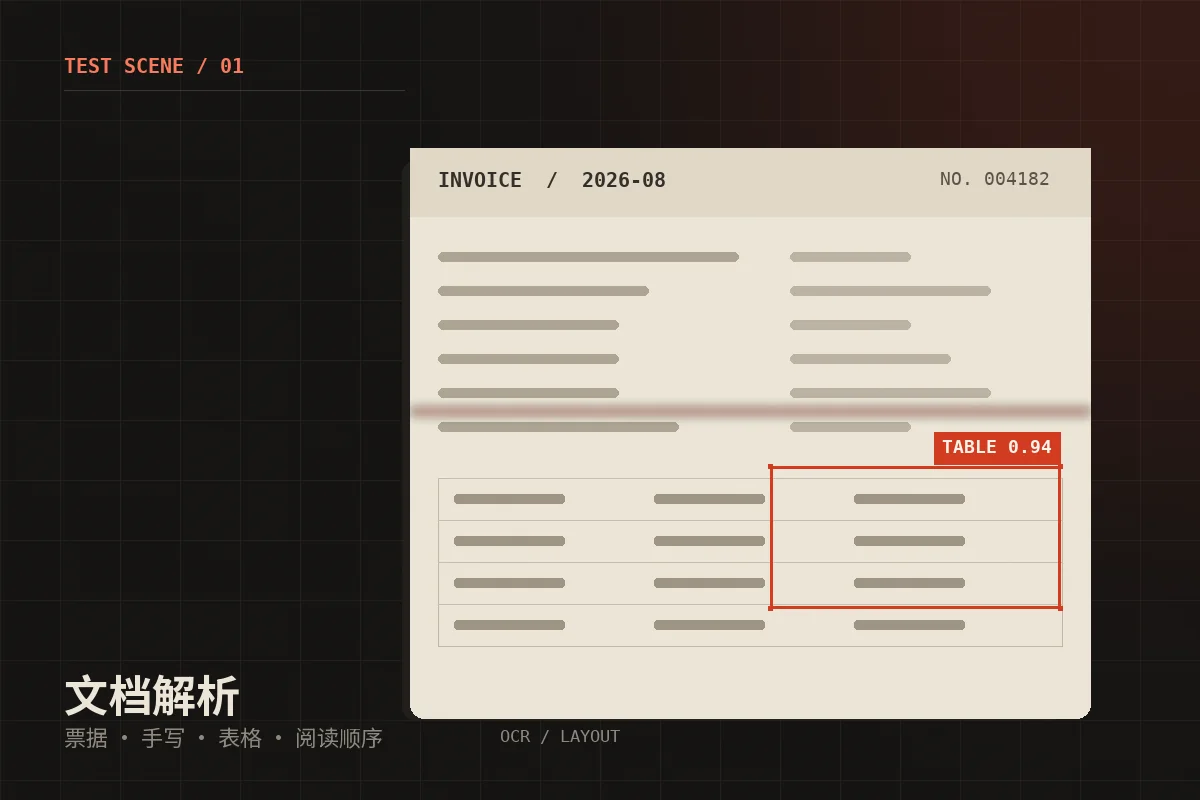
Documents:Receipts, handwriting, tables — 2026 国产多模态模型评测场景示意Documents

Receipts, handwriting, tables

One scan, three measurements: character accuracy, field alignment, reading order.

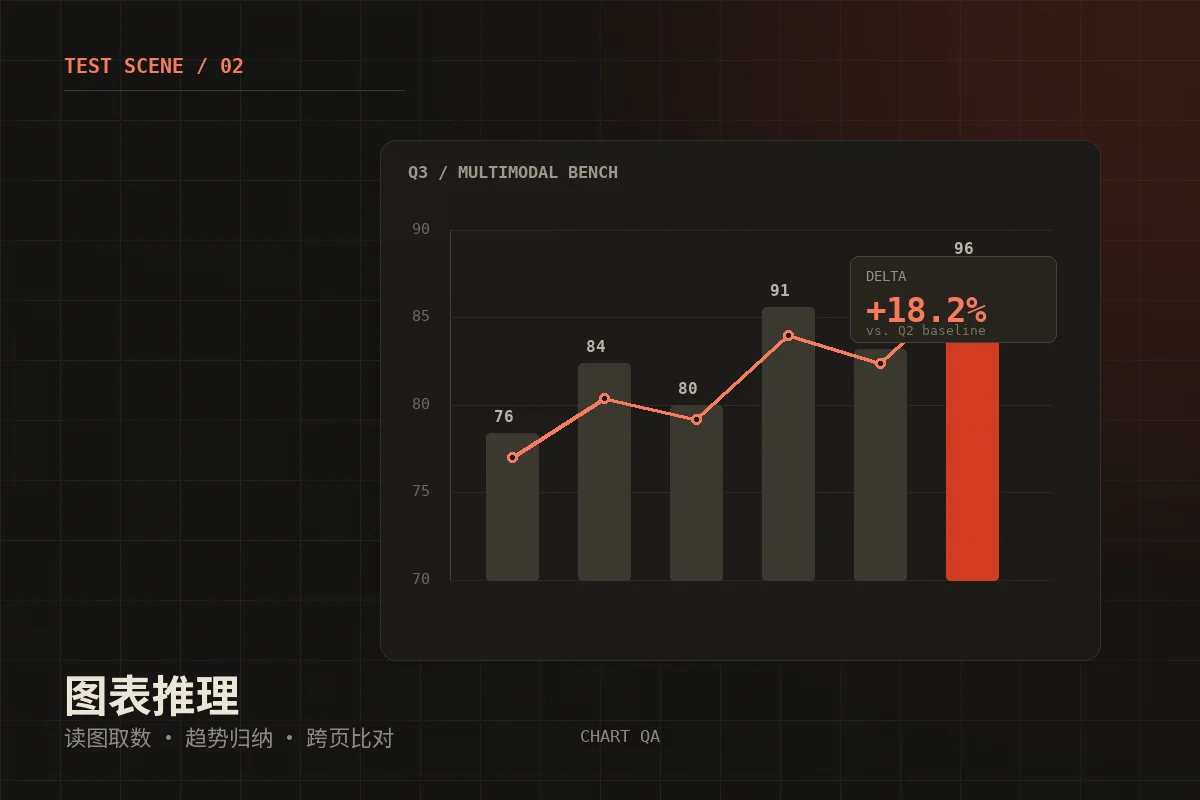
Charts:From extraction to conclusion — 2026 国产多模态模型评测场景示意Charts

From extraction to conclusion

Stacked series, cross-page comparison and unit conversion test reasoning, not OCR.

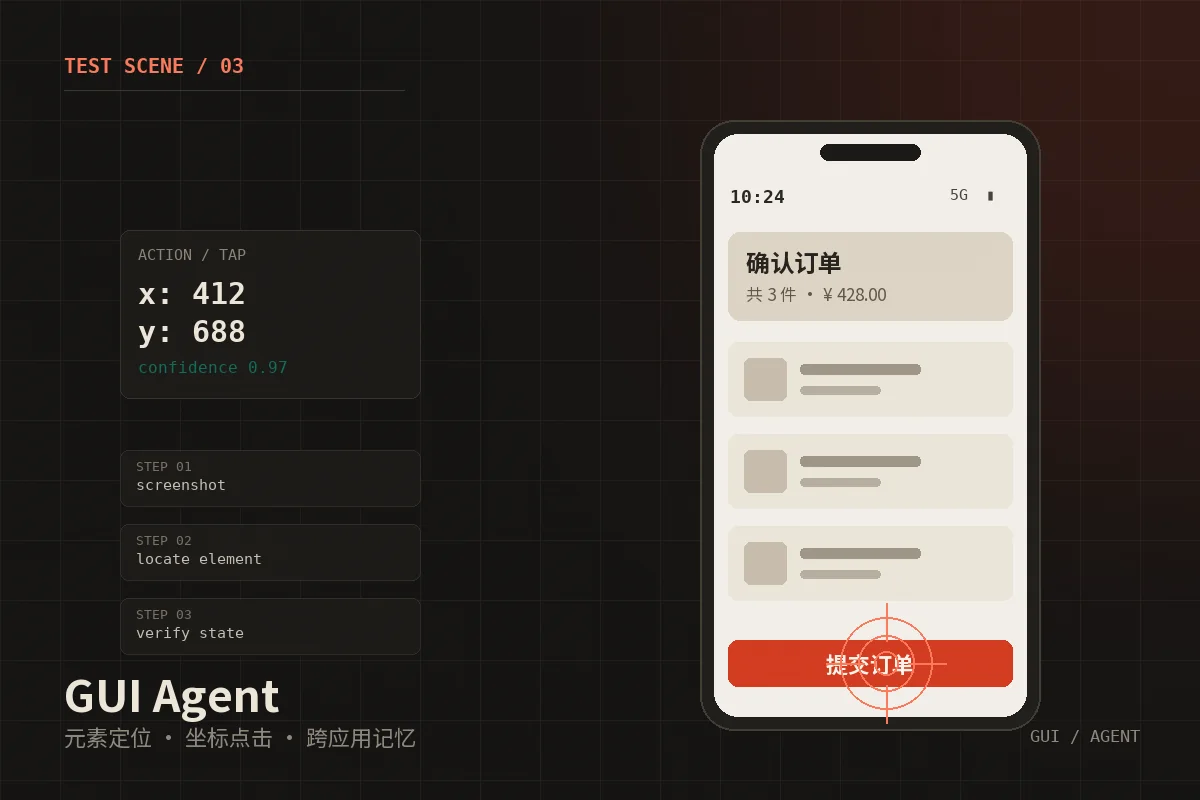
Agents:Screenshot → coordinate → action — 2026 国产多模态模型评测场景示意Agents

Screenshot → coordinate → action

Element grounding, tap precision, cross-app memory and recovery.

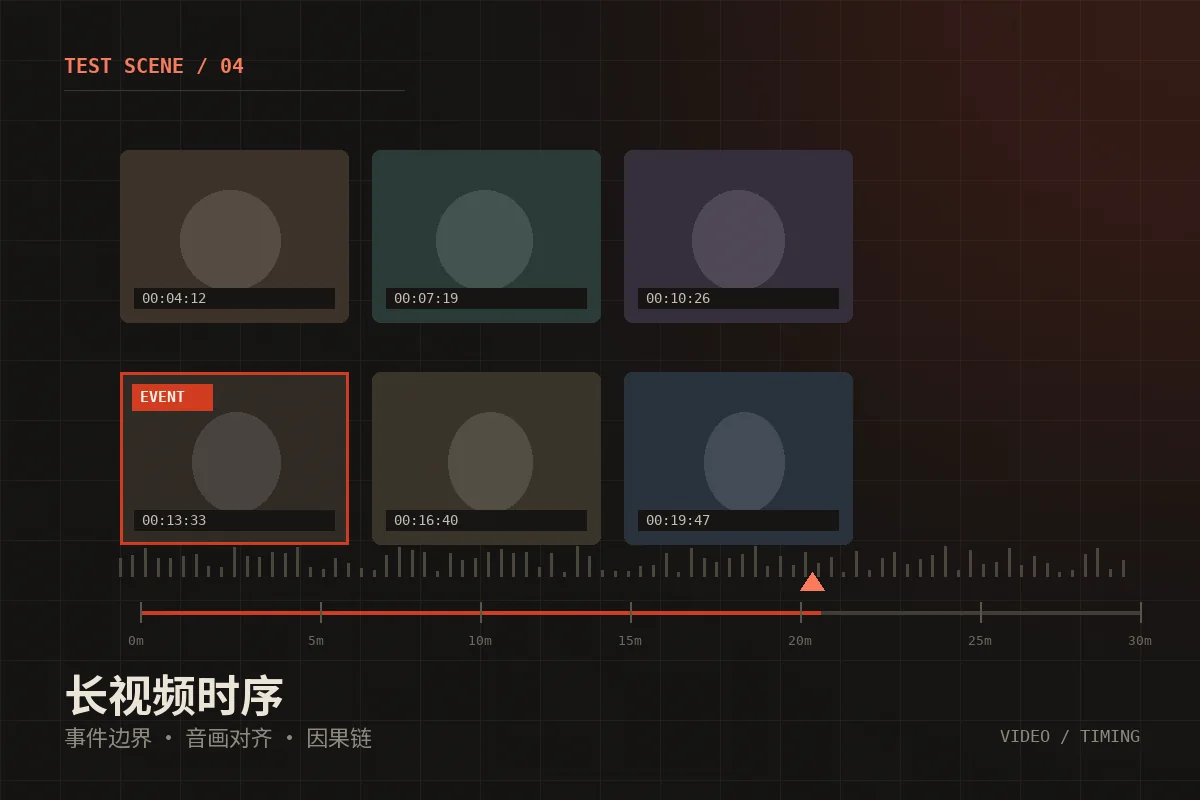
Video:Event boundaries and time — 2026 国产多模态模型评测场景示意Video

Event boundaries and time

Find who did what, when, in 30 minutes of footage — and explain causality.

Price × score

Expensive is not always stronger

X-axis is public output price (log), Y-axis the composite. Open models use estimated self-host cost; closed use public API price. Four key points are labelled; hover the rest.

Calculate your cost
Premium← Value zone7580859095¥0.5¥1¥2¥5¥10¥20Output price (CNY / 1M tokens, log scale)Qwen3.8-Max · 95.4 · ¥18/MQwen3.8-MaxDoubao Seed 2.0 Pro · 95.2 · ¥15/MDoubao 2.0 ProQwen3.5-397B-A17B · 94.6 · ¥12/MQwen3.5GLM-5.3 · 92.4 · ¥9/MGLM-5.3Kimi K3 · 92.3 · ¥16/MGLM-5 · 92.0 · ¥10/MMiMo-V2.5 · 90.1 · ¥6/MMiMo-V2.5SenseNova 6.5 Pro · 89.9 · ¥12/MLongCat-Next · 89.2 · ¥2.5/MQwen3-Omni-30B · 88.9 · ¥4/MERNIE 5.1 · 88.1 · ¥8/MDeepSeek-V4.1-Flash · 87.9 · ¥0.6/MDS-V4.1-FlashQwen3.8-Flash · 87.5 · ¥1.2/MKeye-VL-2.0 · 86.0 · ¥2/MHunyuan-Vision · 85.2 · ¥8.6/MInternVL 4.0 · 85.0 · ¥1/MStep-3 · 84.7 · ¥5/MSpark X2 · 84.5 · ¥6/MMiniMax M2.5 · 83.8 · ¥8/MDeepSeek-OCR 2 · 81.9 · ¥0.8/MDeepSeek-OCR 2Pangu 5.5 · 81.6 · ¥20/MAnt Group Ling 2 · 80.8 · ¥5/MWITA-Omni Preview · 80.6 · ¥0/MEmu3.5 · 80.5 · ¥0/MZidong Taichu 2.0 · 80.1 · ¥0/MMiniCPM-V 4.5 · 79.6 · ¥0.5/MHikvision Guanlan 3 · 78.2 · ¥0/MJD Yanxi 2 · 78.0 · ¥6/MNetEase Fuxi 2 · 77.5 · ¥4/MNeuroXess-N1 · 77.2 · ¥0/MBAGEL-2 · 76.9 · ¥0/MCloudwalk Congrong 2 · 76.1 · ¥7/M

← scroll for the full distribution →

01

MiMo is the value knee

90.1 at ¥6/M: 95% of flagship capability at 40% of the price.

02

Documents ignore the total

DeepSeek-OCR 2 gets document 99 at ¥0.8/M — about 1/18 the per-page cost of a flagship.

03

Doubao’s premium buys stability

2.5× the price, but fewer long-task failures and better Chinese long tail — suited to unattended pipelines.

Full heatmap

The whole 20 × 8 grid at a glance

Darker means higher. Rows follow the composite; scroll horizontally. Weights are in parentheses.

Full ranking
ModelPerception20%Document18%Chart QA14%Video14%Agent14%Generation6%Chinese6%Ecosystem8%Overall
Qwen3.8-Max979796939590959695.4
Doubao Seed 2.0 Pro979694969388979895.2
Qwen3.5-397B-A17B969795929290949894.6
GLM-5.3939491889585959792.4
Kimi K3959293909584939092.3
GLM-5939592889189959292.0
MiMo-V2.5919089939086908890.1
SenseNova 6.5 Pro949390898687928289.9
LongCat-Next929491878892897289.2
Qwen3-Omni-30B909187908488919088.9
ERNIE 5.1909289858284938888.1
DeepSeek-V4.1-Flash909592788572869587.9

Top 12 shown; see the tier list for all 24. Scores are 0–100 editorial mappings, not any single public benchmark.

Why trust it

Disagree with the score — but the method is public

Weights, sources and uncertainty are all on the record. Copy the table, change the weights, and get a ranking for your own business.

01

Open weights

All eight dimensions and percentages are listed; swap in your own.

02

Evidence grades

A third-party reproduced, B official plus partial, C single source.

03

Traceable updates

Every change lands in the changelog; old scores stay visible.

FAQ about this tier list

Which Chinese multimodal model is best in 2026?

On our weighted 8-dimension score, Alibaba Qwen3.8-Max ranks first at 95.4 and ByteDance Doubao Seed 2.0 Pro second at 95.2, then Qwen3.5-397B-A17B at 94.6, with GLM-5.3 and Kimi K3 next. Anything inside 0.5 is one band, so the top two are tied — the real difference is the evidence grade: B for Qwen3.8-Max, A for Doubao. By single task: DeepSeek-OCR 2 leads documents, Doubao leads video, and DeepSeek-V4.1-Flash leads value. Among the 26 listed, InternVL 4.0 is the open-source perception ceiling and NeuroXess-N1 the only neural-signal entrant.

Why are security-vendor, e-commerce and game-company models on this list?

Because “scenario exclusivity” and “general capability” are two different products. Hikvision Guanlan (surveillance video), JD Yanxi 2 (product images) and NetEase Fuxi 2 (game content) rank 22nd or lower overall, yet each is the only contender in its scenario — surveillance data cannot be published, product-image corpora are exclusive, and content generation is scenario-bound, none of which general comparisons can measure. We sample across five classes — general flagships, specialists, cold models, open source and industry scenarios — at the cost of maintenance, in exchange for coverage. The full scenario-to-model mapping is in the industry exclusivity map.

How is this different from SuperCLUE or LMArena?

Those are third-party evaluations whose public scores we cite. Our composite re-weights eight dimensions for selection work and adds an A/B/C evidence grade. The goal is “which model fits your scenario”, not replicating one leaderboard.

Why is a brain-computer-interface company (NeuroXess) on this list?

Because neural-signal decoding is a scenario only it is tested on, and covering the only option is exactly what separates this board from ordinary comparisons. It ranks 25th, carries evidence grade C (all figures vendor-reported), and has no public API — we label all three honestly and let you decide whether it belongs in your shortlist. The same logic applies to all fifteen cold models: InternVL 4.0 (top-three open-source community heat, absent from comparisons), Hikvision Guanlan (the only surveillance-video specialist) and Ant Ling 2 (the finance-scenario model with Chinese 92) — 16th or lower overall, no second place in their scenario.

Why is DeepSeek-OCR 2 only 81.9 overall yet recommended for documents?

The composite covers eight dimensions, and DeepSeek-OCR 2 has no video, audio or agent support, so its coverage penalty is large. On documents it scores 99 and reaches 91.09 on OmniDocBench v1.5 at a fraction of flagship pricing. Read dimension scores, not just the total.

How can I tell native multimodality from bolt-on vision?

Look for a unified visual tokenizer, an end-to-end joint objective and cross-modal ablations. An adapter that bolts an image encoder onto a language model is bolt-on. We tag every model as native or bolt-on.

How often is the list updated and where does the data come from?

Routine updates land on the first Monday of each month; major releases are added within 72 hours. Sources include official technical reports, SuperCLUE-VLM, LMArena, OpenRouter usage, community reproductions and public price pages, listed on each model page.

Can I cite the charts and conclusions?

Yes. Content is CC BY 4.0. Please credit “CN Multimodal Tier List (2026cnmllmtierlist.datacorp.top)” and link to the source page. Corrections and commercial enquiries go through the about page.

Personal ranking · Not an official score

Every ranking, score and comparison on this page is an independent personal ranking, not an official score, and represents no vendor, institution or regulator. Scores are a subjective mapping of public evidence under our own weights — change the weights and the order changes. Disagree, or spotted a factual error? Contact the site owner: jizhi2024@foxmail.com — we check each report and log corrections in the changelog.